



For many of us who have called the Phoenix area our home for the last several decades, it has been hard to miss all of the changes throughout the valley. New commercial centers, new freeway systems, and, of course, many more people and much more housing. The North Valley up near Loop 303, in particular, has transformed from the quiet suburbs of Phoenix, where most people commuted for work, into one of the strongest growth corridors in the state. With billions of dollars invested by TSMC and Amkor, broad stretches of desert land have been converted into high-tech manufacturing facilities, supporting infrastructure, housing, retail, and more.
Today we’re going to talk about what these changes could mean for the North Valley in terms of home values, jobs, and the long-term economic growth of the area. This topic is important because, while Phoenix has been attracting new residents for some time, population growth alone does not create a thriving economy; to sustain it, you must also have a foundation of a strong workforce.
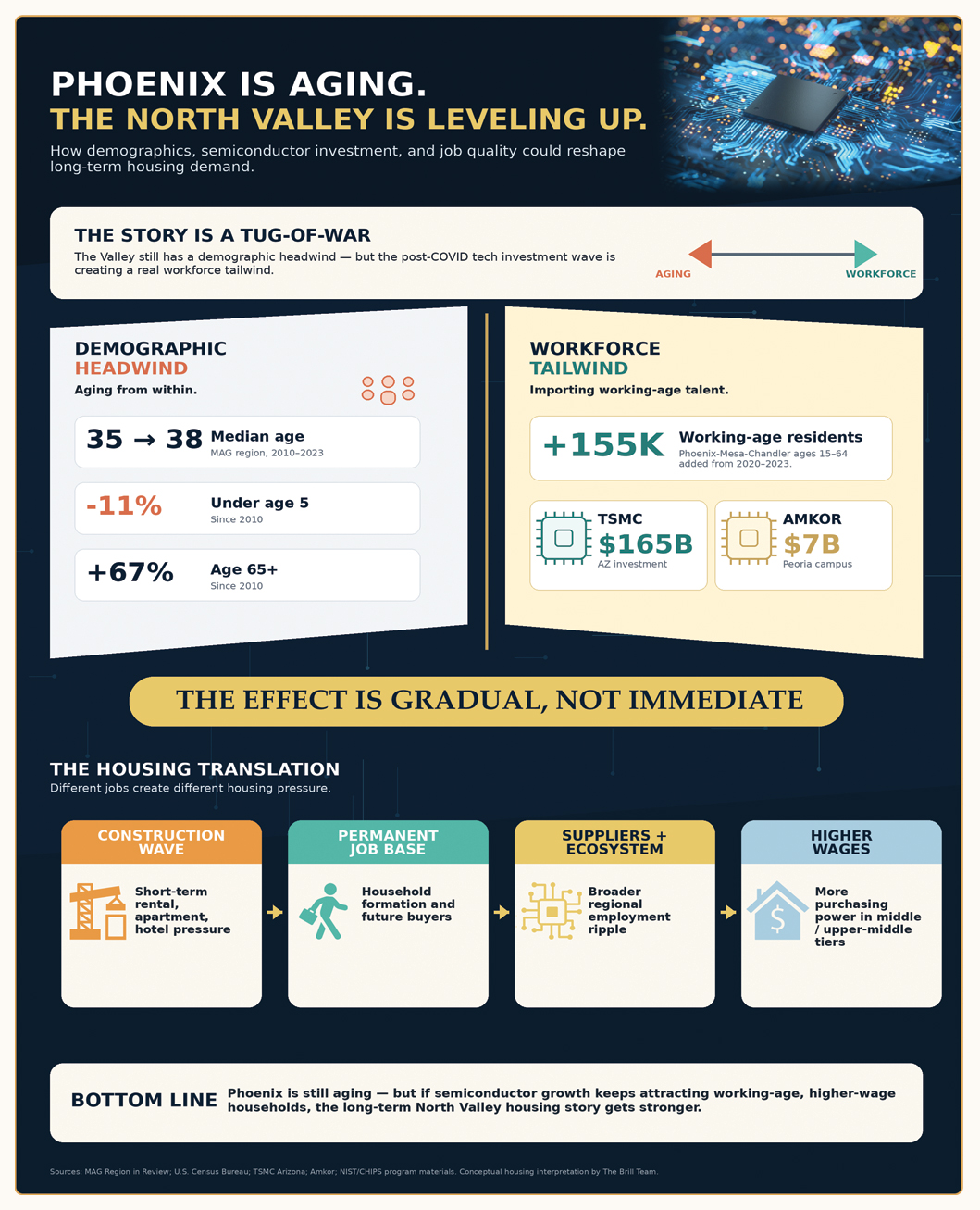
In recent years, there have been quiet concerns about the long-term strength of the economy and housing market growth potential in Phoenix. These concerns have not been rooted in typical issues like supply and demand, interest rates, or affordability. Rather, demographic shifts over the previous decade and a half have been the concern, and for good reason. The Maricopa Association of Governments (MAG) reports that from 2010-2023, the median age has risen from 35 to 38. Both ends of the age spectrum have been headed in opposite directions. One key indicator of the future workforce growth, the youngest population (under age 5) has declined by 11%, while the over 65 demographic has risen by 67%.
While these numbers could be concerning, there are, in fact, many good reasons to be optimistic about the future of the Phoenix area. The US Census Bureau reports that 155,000 working age residents have been added to the Greater Phoenix Area population between 2020 and 2023. While not directly attributable to the semiconductor industry, companies like TSMC and Amkor serve as employment anchors that drive the economic engine of an area.
What began as a substantial $12 billion investment in 2020, has blossomed into a colossal $165 billion commitment, which extends well into the next decade. Likewise, Amkor has committed $7 billion, which is up from the original $2 billion that was initially planned. These massive scale projects usher in a wave of new jobs, including tens of thousands of industrial construction labor positions and specialized engineers. Since construction will take several years to complete, these jobs are a mix of permanent and contract workers, meaning that the housing demands include everything from short-term hotels, corporate rental housing, and long-term purchases. Once fully operational, TSMC and Amkor project that approximately 9,000 skilled, high-wage jobs will be created, which could support far more household formation, relocation, and long-term housing demand throughout the North Valley.
Additionally, economic models are forecasting a 1:5 employment multiplier, meaning that every single permanent job created at the two plants could create another 4-5 indirect jobs throughout the wider community. From industry specific suppliers and contractors, to retail, restaurants, hospitality, schools and medical, the employment ecosystem is vast. This global economic infusion has the potential to effectively create a sustainable counterbalance to the aging demographic, which could serve to stabilize the economy and the housing market for years to come.
One of the questions I am asked most often when it comes to this topic is specifically regarding housing prices. Many of the people I meet with who are considering buying or selling a home, are considering the timing of their decision based around these two projects. As much of what I outlined above certainly points to growth and strong appreciation, it should be very clearly understood that this is a gradual effect, not an immediate one. New residents to an area will absolutely need a place to live, but not all will purchase, or at least not initially.
To the broader question of whether or not I think this will ultimately positively affect the home values of the North Valley, I would simply say, how could it not? However, like all good things, this comes with time. Value appreciation does not care about TSMC or Amkor, it simply follows the principle of supply and demand. These projects have and will continue to create housing demand, but until there are not enough homes available for sale to satisfy that demand, values will likely remain stable for some time. So, if you’re considering buying or selling a home anytime in the near future and would like to discuss your specific situation or have your own questions related to this topic, please give me a call. I would love to talk nerdy with you :)
