



Over the last few years there has been a lot of talk about the notable shift our market has experienced since the second half of 2022. While I know my own commentary has addressed the changes, I must admit that the comparison of today’s market to that of 2021-2022 isn’t quite fair, because the COVID pandemic created a true perfect storm of events that led to the most frenzied seller’s market ever seen. Today, let’s provide some much needed context to this topic by comparing our current local market to the years before the disruption of the pandemic. We’ll compare to a more “normal market”, like the years of 2018-2019, and I think you’ll see that other than the much higher sales price, the comparison isn’t quite so stark.
Today, as we go back in time, we’re going to focus on three main metrics (sales volume, median days on market and median sales price) and three distinct time periods. The years of 2018-2019 serve as a solid benchmark for a relatively typical, mild seller’s market, while 2021-2022 represent a true anomaly. When referring to the current market, we’re talking about the years between 2024-2026. Lastly, since I’m writing this mid-year, we’re looking for consistency by comparing data for all years from January through May.
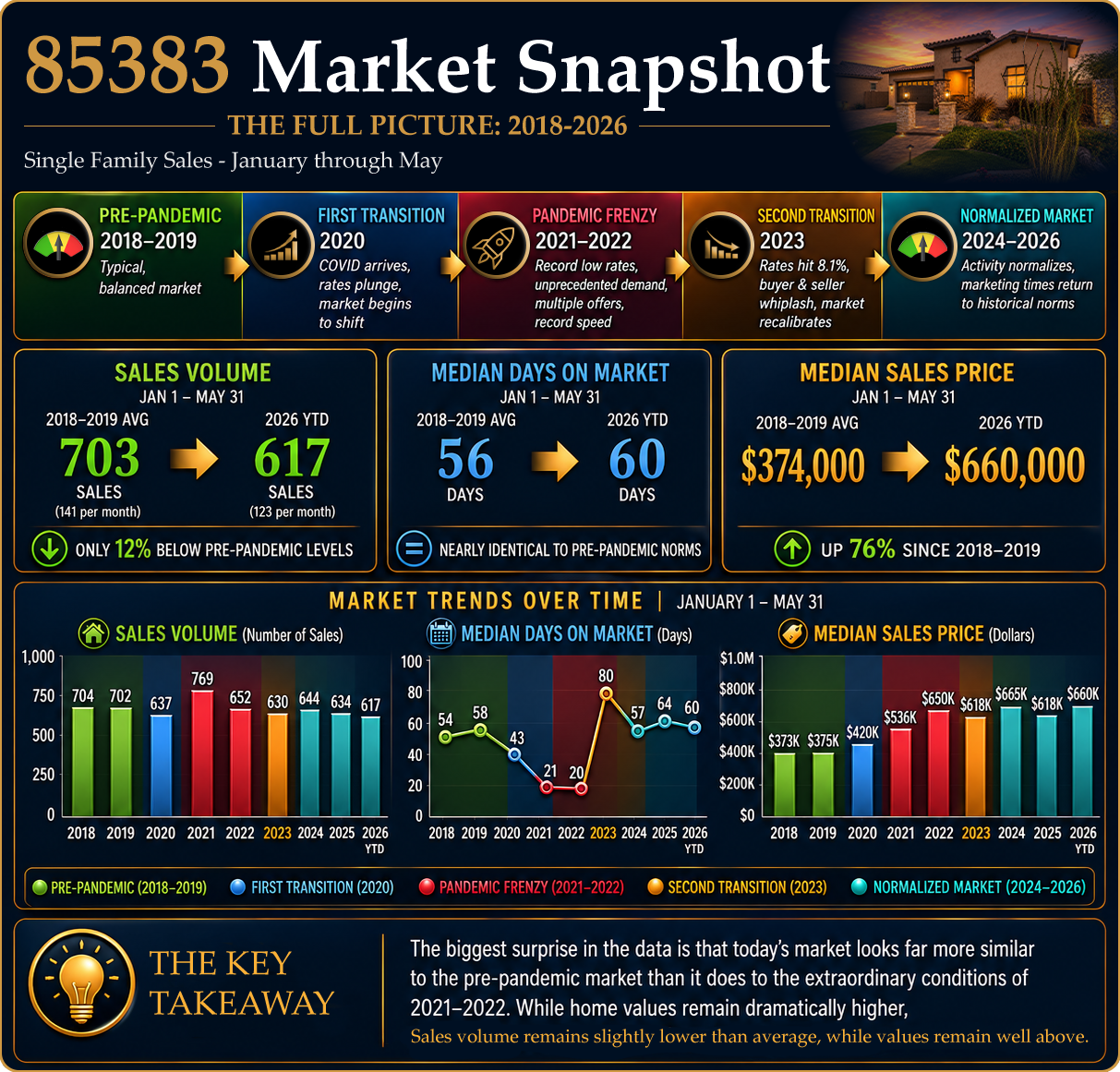
In the pre-pandemic years, the market was strong and was balanced in favor of sellers, with a steady deterioration of supply year over year. Conversely, demand was continuing to rise, with a sales volume of about 140 sales per month in the 85383 zip code. Days on market were still low by the standard of most metro areas at 56 days, but buyers did not have to feel rushed to make decisions and had time to shop. Having worked in many markets, I think I would call the pre-pandemic years a bit of a sweet spot for both buyers and sellers. Homes were selling fairly quickly, and values were steadily rising at about 5-7% each year. Buyers appreciated 4 to 5% mortgage rates, still had room to negotiate, and could still expect solid appreciation in the years following their purchase. Both buyers and sellers had great reasons to be happy.
This period of steady growth actually began in about 2015, and the pressure slowly built as supply dwindled each year, and ultimately crescendoed in mid-2020 when listing inventory collapsed and buyer demand skyrocketed. The perfect storm I alluded to was certainly exacerbated by COVID, but was a situation that had been brewing for years. When many other states were fully locked down, Arizona was attracting droves of new residents who were eager to buy, with very few homes available for sale. Most homes sold in days, if not hours, and there were bidding wars on nearly every listing for tens of thousands of dollars over the asking price, leading to a peak in home value appreciation in 2021 of nearly 40%. While the frenzy of this extraordinary market was relatively short-lived, the lion's share of that monumental gain remains intact today, even if some areas or pockets have depreciated some since the peak.
This leaves us now in today’s market, which I have previously described both as quiet and unremarkable. On this last point, I want to provide clarification out of respect for what many home sellers are feeling today. I said it is unremarkable because the data is in line with a much more normal market. Coming from an exciting market where homes were selling Ninja Fast and for well over “top dollar”, the sudden shift left many feeling a bit of whiplash, and that’s fair. The reason for today’s article was to shed light on why we must be careful to not compare to the extremes. COVID brought about extenuating circumstances that we’ve never seen before, and likely (hopefully) will never see again. Inventory is higher today, but within the normal range. Demand remains low because of the higher interest rates, but that will likely self-correct when rates come down. If you’re expecting to sell your home in the first weekend, 60 to 90 days might feel like a long time. If, however, you go into it with the understanding that it may take a few months, your patience will be rewarded. While fewer homes are selling overall than before or during the pandemic, values are still a whopping 76% higher than they were prior to 2020. So, if you’re considering selling your home anytime in the near future and would like to discuss your specific situation. Please give me a call. I’d love to talk nerdy with you :)